Choosing the right payment gateway is an important decision for any ecommerce or online business. The gateway you choose can affect payment success rates, transaction costs, customer experience, international payments and even how easily you can manage your WooCommerce checkout.
For businesses in India, CCAvenue and PayU are two established payment gateway options. Both support popular Indian payment methods such as cards, UPI and net banking, while also offering solutions for international payments.
But which one is better in 2026?
CCAvenue can be a particularly strong choice for businesses that need Indian payments along with international and multi-currency payments, including AED for UAE customers. PayU is also a strong option, especially for businesses focused on India’s digital payment ecosystem and international expansion.
The right choice ultimately depends on your business model, target market, payment methods, pricing and integration requirements.
In this guide, we compare CCAvenue vs PayU in 2026 across pricing, payment methods, international payments, currencies, WooCommerce integration, recurring payments, security and overall suitability. For a three-way view, see our CCAvenue vs Razorpay vs PayU comparison.
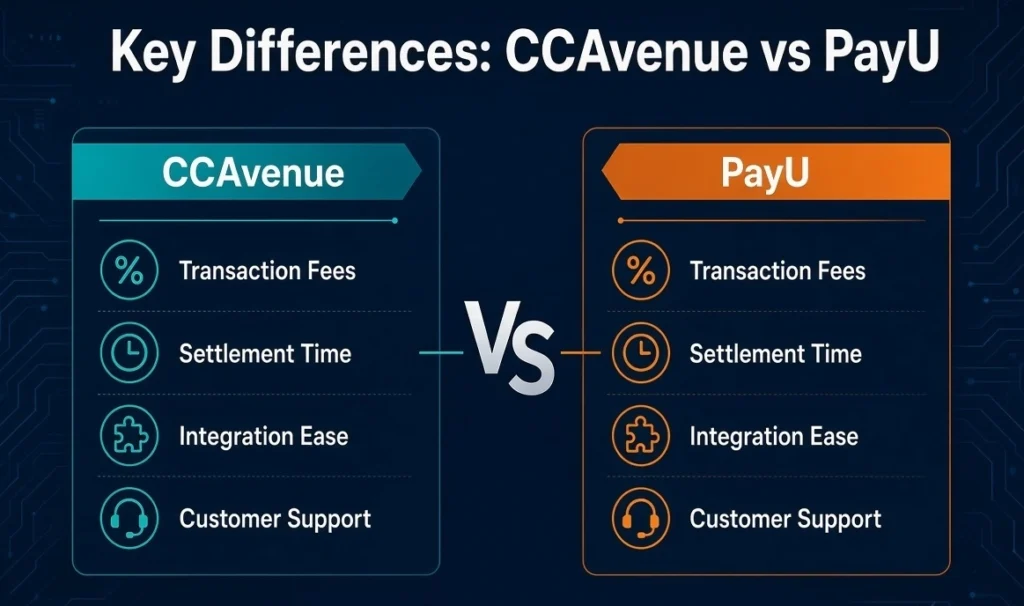
CCAvenue vs PayU: Quick Comparison
| Feature | CCAvenue | PayU |
|---|---|---|
| Domestic Indian payments | Excellent | Excellent |
| UPI | Yes | Yes |
| Credit & debit cards | Yes | Yes |
| Net banking | Yes | Yes |
| Wallets | Yes | Yes |
| EMI | Yes | Yes |
| International payments | Yes | Yes |
| AED / UAE payments | Yes | Yes |
| Multi-currency payments | Yes | Yes |
| WooCommerce integration | Available | Available |
| Recurring payments | Available | Available |
| Best for | India + international businesses | India + international businesses |
Both gateways offer a broad set of features. The differences become more important when you look at international payments, pricing, currencies and the specific requirements of your website.
What Is CCAvenue?
CCAvenue is an established payment gateway used by businesses to accept online payments in India and international markets.
CCAvenue supports a wide range of payment methods, including credit and debit cards, UPI, net banking, prepaid instruments and EMI options. Its current payment gateway information lists 6 credit cards, 58+ net banking options, UPI, 97+ debit cards, 13 prepaid instruments and 15 bank EMI options.
One of CCAvenue’s biggest advantages is its multi-currency payment capability.
CCAvenue currently states that merchants can accept payments in 27 major foreign currencies, including USD, GBP, EUR, AED, SAR, SGD, CAD and several others.
That can be particularly useful for Indian businesses selling products or services to customers in the UAE, Saudi Arabia, Europe, the UK and other international markets.
CCAvenue also provides features such as tokenisation, recurring payments, transaction reporting and multiple integration options.
For businesses that want to combine Indian payment methods with international currencies, CCAvenue is therefore worth considering.
What Is PayU?
PayU is another major payment gateway serving businesses in India.
PayU provides access to a broad range of payment methods, including cards, UPI, net banking, wallets, EMI and BNPL options. Its current pricing information highlights 150+ payment modes across its payment ecosystem.
PayU also provides international payment solutions for businesses expanding beyond India. Its international payments offering states that businesses can accept payments in 100+ currencies, display prices in multiple currencies and receive settlements in INR for international transactions.
For Indian businesses that want extensive domestic payment coverage while also preparing for international expansion, PayU is a strong alternative to CCAvenue.
CCAvenue vs PayU: Pricing in 2026
Pricing is one of the first things businesses compare when selecting a payment gateway.
However, you should not compare only the headline percentage. The actual cost can depend on the payment method, domestic or international transaction, business category, transaction volume and your merchant agreement.
CCAvenue pricing
CCAvenue’s current published standard pricing lists 2% platform fees for online payments, with 18% GST applicable. Its published pricing also lists:
- 3% for international credit and debit cards
- 3.5% for multi-currency processing
- 3% for American Express and Diners Club cards plus EMI
- 3.5% for cardless EMI
- No setup fee under its standard pricing
CCAvenue also offers customised pricing for businesses with larger transaction volumes.
PayU pricing
PayU currently publishes the following standard rates:
- 2% for Visa, Mastercard, net banking, BNPL and wallets for domestic transactions
- 3% for Diners, American Express, EMI and international transactions
- 18% GST applicable
- No setup fee
- No annual fee under the published standard pricing model
PayU also offers customised pricing for businesses based on factors such as transaction volume and business requirements.
Which is cheaper?
There is no universal winner.
For standard domestic transactions, the published base rates are similar. The difference becomes more important when you process international or multi-currency transactions.
CCAvenue currently publishes a 3.5% platform fee for multi-currency processing, while international cards are listed at 3%.
PayU currently lists international transactions under its 3% pricing category on its standard pricing page.
Always request the final commercial proposal from the payment gateway before making a decision, particularly if your business has significant international transaction volume.
Payment Methods: CCAvenue vs PayU
Payment methods directly affect the checkout experience.
Customers are more likely to complete a purchase when their preferred payment method is available.
CCAvenue
CCAvenue supports:
- Credit cards
- Debit cards
- UPI
- Net banking
- Wallets
- EMI
- International cards
- Multi-currency payments
CCAvenue’s current payment gateway information lists a particularly broad selection of Indian payment options.
PayU
PayU supports:
- Credit cards
- Debit cards
- UPI
- Net banking
- Wallets
- EMI
- BNPL
- International cards
- Other digital payment methods
PayU currently promotes 150+ payment modes across its payment infrastructure.
Winner
For most Indian ecommerce businesses, both are strong.
If your customers mainly use UPI, cards and net banking, you are unlikely to find a major difference based purely on basic payment-method availability. Our guide to enabling UPI, cards and net banking on CCAvenue covers how those modes are activated at the account level.
International Payments: CCAvenue vs PayU
International payments are increasingly important for Indian businesses.
A software company in India may sell subscriptions to customers in the UAE. An ecommerce business may sell products to customers in the UK. A consultant may receive payments from clients in the US.
In these situations, the ability to accept international cards and display familiar currencies becomes important.
CCAvenue for international payments
CCAvenue supports international card payments and multi-currency processing.
Its current information states that merchants can collect payments in 27 major foreign currencies, including:
- USD
- GBP
- EUR
- AED
- SAR
- SGD
- CAD
- AUD
- JPY
- CHF
and others.
The inclusion of UAE Dirham (AED) can be particularly useful if your business targets customers in the UAE.
CCAvenue also provides multilingual checkout functionality, which can help businesses create a more localised payment experience.
PayU for international payments
PayU also provides an international payment solution.
Its current international payments information states that businesses can accept payments in 100+ currencies and display prices in multiple currencies. It also offers real-time currency conversion and international payment solutions for businesses expanding globally.
Which is better for international payments?
Both are capable.
CCAvenue has a strong advantage if your business specifically needs its established multi-currency setup and AED support.
PayU is attractive if you want a broader international currency footprint and PayU’s international payment infrastructure.
For either gateway, international payments may require activation, eligibility checks or additional merchant approval. Therefore, confirm your exact requirements before implementation.
CCAvenue vs PayU for UAE Customers
If your business is based in India but sells to UAE customers, currency support becomes especially important.
A customer in Dubai or Abu Dhabi may be more comfortable seeing a price in AED instead of INR or USD.
CCAvenue explicitly lists UAE Dirham (AED) among its supported currencies.
PayU also supports international payments and includes AED within its international payment capabilities. Its international solution supports 100+ currencies.
For businesses targeting the UAE, don’t look only at whether AED is technically supported. Also check:
- International transaction fees
- Currency conversion charges
- Settlement currency
- Settlement time
- Refund handling
- International card acceptance
- Merchant approval requirements
- Fraud and risk controls
These factors can have a bigger financial impact than the basic gateway fee.
CCAvenue vs PayU for WooCommerce
If you run a WooCommerce store, payment gateway integration is another major consideration.
A payment gateway should integrate properly with your checkout and handle:
- Successful payments
- Failed payments
- Cancelled transactions
- Refunds
- Payment callbacks
- Order status updates
- Currency handling
- Webhooks where required
- Testing and production credentials
PayU provides WooCommerce integration documentation and supports multiple integration methods for merchants.
CCAvenue is also commonly integrated with ecommerce websites and supports multiple integration approaches — our CCAvenue WooCommerce integration guide walks through the full setup.
However, there is an important point that WooCommerce store owners sometimes overlook:
The payment gateway and the WooCommerce plugin are two separate considerations.
Even if CCAvenue or PayU has reliable payment infrastructure, an outdated or poorly maintained WordPress plugin can cause checkout issues — see the common CCAvenue integration errors that trip up WooCommerce stores.
When selecting a WooCommerce payment solution, check the plugin’s:
- WooCommerce compatibility
- WordPress compatibility
- HPOS compatibility
- Checkout compatibility
- Currency support
- Webhook handling
- Refund support
- Developer support
- Update frequency
For businesses specifically looking for a CCAvenue integration for WooCommerce, you can explore TechBella Payment Gateway Pro – CCAvenue India & UAE.
Recurring Payments and Subscriptions
Recurring payments require additional consideration if you operate:
- SaaS products
- Membership websites
- Subscription services
- Software licensing
- Online courses
- Recurring service businesses
CCAvenue currently lists recurring payments for credit and debit cards, including mandate creation and modification, validation and notification charges.
However, gateway-level recurring payment support does not automatically mean that every WooCommerce subscription plugin will work with it.
Before choosing a gateway for subscriptions, confirm compatibility between:
Payment gateway → WooCommerce → Subscription plugin → Recurring payment method
You should also check how the integration handles failed renewals, cancellations, refunds and payment authentication.
Security and Reliability
Security is one of the most important factors when processing online payments.
Both CCAvenue and PayU provide payment infrastructure designed for secure online transactions.
PayU states that its infrastructure is PCI-DSS compliant and includes security and risk-management capabilities.
CCAvenue also provides secure payment processing and tokenisation capabilities through its CCAvenue Vault offering. Its current pricing information lists tokenisation services as an available value-added service.
For WooCommerce merchants, gateway security is only one part of the overall security picture.
You should also keep:
- WordPress updated
- WooCommerce updated
- Payment plugins updated
- SSL enabled
- Admin accounts protected
- Unused plugins removed
- Backups configured
A secure payment gateway cannot compensate for an insecure WordPress installation — see our WordPress security best practices for WooCommerce stores.
CCAvenue vs PayU: Advantages and Disadvantages
CCAvenue Advantages
- Strong Indian payment coverage
- International card support
- Multi-currency processing
- AED support for UAE customers
- Wide range of currencies
- UPI, cards, net banking and EMI
- Recurring payment capabilities
- Tokenisation options
- Suitable for Indian businesses expanding internationally
CCAvenue Disadvantages
- International and multi-currency transactions can have higher fees
- Merchant approval may be required for some payment capabilities
- Final commercial rates can vary by business
- WooCommerce experience depends partly on the integration plugin
PayU Advantages
- Extensive Indian payment ecosystem
- 150+ payment modes
- Strong UPI and domestic payment coverage
- International payment capabilities
- 100+ supported international currencies
- Multiple integration options
- Custom pricing available for larger businesses
- Strong focus on payment optimisation
PayU Disadvantages
- International payment pricing is higher than standard domestic pricing
- Some international features require activation
- Final rates can vary by merchant and business model
- WooCommerce experience depends on the integration being used
Which Payment Gateway Is Better for Your Business?
There is no single answer for every merchant.
Choose CCAvenue if:
- Your business serves Indian customers
- You also target international customers
- UAE customers are important
- You need AED payments
- You need multi-currency processing
- You sell software, services or ecommerce products internationally
- You need recurring payment capabilities
- You are building a WooCommerce store around CCAvenue
Choose PayU if:
- India is your primary market
- UPI is a major payment method for your customers
- You want a large selection of Indian payment methods
- You are expanding internationally
- You need support for a large number of international currencies
- You want PayU’s broader payment ecosystem
CCAvenue vs PayU: Our Verdict for 2026
So, is CCAvenue better than PayU in 2026?
The answer depends on your market.
For a business focused almost entirely on Indian customers, both CCAvenue and PayU are strong choices. Their domestic payment capabilities are extensive, and their published standard pricing is competitive.
For businesses targeting India + UAE + international customers, CCAvenue deserves particular attention.
Its combination of Indian payment methods, international card acceptance, multi-currency processing and explicit AED support makes it a practical option for businesses that want to serve customers across multiple markets.
PayU is also a strong international option, particularly if you want access to its broader international currency offering and payment infrastructure. PayU currently states that its international solution supports 100+ currencies.
The most important thing is not to choose based only on the advertised transaction fee.
Instead, compare:
- Your domestic transaction rate
- International transaction rate
- Multi-currency charges
- Currency conversion costs
- Settlement terms
- Supported currencies
- Payment success rates
- Recurring payment support
- WooCommerce compatibility
- Merchant support
For many growing businesses, a slightly higher transaction fee can be worthwhile if the payment experience is more reliable and better suited to their customers.
Frequently Asked Questions
Is CCAvenue better than PayU?
Neither gateway is universally better. CCAvenue is particularly attractive for businesses that need Indian and international payments with multi-currency and AED support. PayU is a strong alternative with extensive Indian payment methods and international payment capabilities.
Is CCAvenue cheaper than PayU?
Not necessarily. Both have competitive domestic pricing. CCAvenue currently publishes 2% for standard online payments, while PayU publishes 2% for several domestic payment categories. International and specialised payment charges differ.
Does CCAvenue support AED?
Yes. CCAvenue explicitly lists UAE Dirham (AED) among its supported currencies and states that it supports 27 major foreign currencies.
Does PayU support AED?
Yes. PayU’s international payment solution supports a wide range of currencies, including AED, as part of its international payment capabilities.
Which is better for WooCommerce, CCAvenue or PayU?
Both can be used with WooCommerce. The better choice depends on your required payment methods, target countries, currencies, subscription requirements and the quality of the WooCommerce integration you use.
Which payment gateway is better for international customers?
Both support international payments. CCAvenue is particularly suitable if you need its multi-currency processing and AED support, while PayU offers a broader international currency footprint.
Can I accept international payments with CCAvenue in WooCommerce?
Yes, CCAvenue supports international and multi-currency payments, subject to the applicable merchant eligibility and activation requirements.
Going with CCAvenue on WooCommerce?
TechBella’s CCAvenue Pro payment gateway plugin is built for stores selling in India and the UAE — AED and INR checkout, multi-currency support, reliable order-status sync and Cart & Checkout Blocks compatibility.
Final Thoughts
CCAvenue vs PayU is not simply a question of which gateway has the lowest fee.
Both are established payment gateways with extensive payment options for Indian businesses. The better option depends on where your customers are located, how they prefer to pay and whether you need international or recurring payments.
If your business primarily serves India, either gateway can be a strong choice.
If you are building a business that serves India, the UAE and international customers, CCAvenue is worth considering because of its combination of domestic payment methods, international cards and multi-currency support, including AED.
For WooCommerce businesses that want to integrate CCAvenue into their store, TechBella Payment Gateway Pro – CCAvenue India & UAE provides a dedicated option to connect CCAvenue with WooCommerce.
Before going live, compare the commercial terms offered specifically to your business and test the complete checkout flow in your target currencies.
The best payment gateway is the one that gives your customers a reliable payment experience while keeping your transaction and operational costs under control.