



























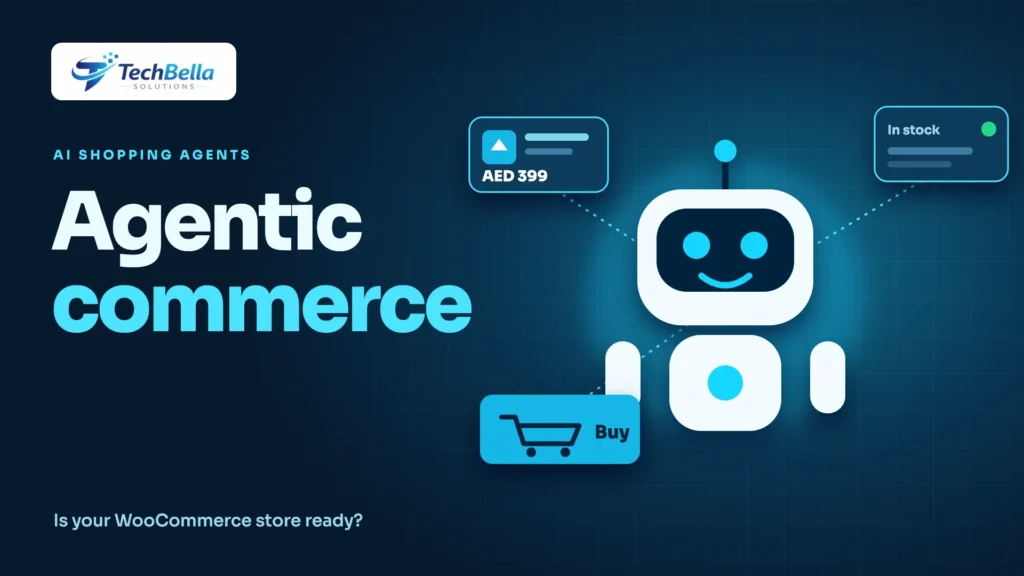
For years, online shopping has followed one pattern: a person searches, clicks, compares and buys. The newest idea in ecommerce is that part of this work will be done by an AI assistant acting on the shopper’s behalf. Ask an assistant for “a waterproof jacket under AED 400 delivered to Dubai by Friday”, and it searches, compares and, in some setups, completes the purchase. This is what people mean by agentic commerce, and it is one of the most discussed topics in ecommerce right now.
Should a WooCommerce store owner care today? Yes, but calmly. The technology is moving fast, much of it is still early or limited to approved partners, and a lot of the writing about it is promotional. This guide explains agentic commerce in plain terms, separates what is real from what is still forming, and gives you a readiness checklist you can act on without betting your business on any single protocol. Most of what makes a store “agent-ready” turns out to be good ecommerce practice anyway.
What is agentic commerce?
Agentic commerce describes shopping where an AI agent does tasks that a person used to do: finding products, comparing options, checking availability and, increasingly, placing the order. “Agent” means the software acts toward a goal with some independence, rather than just answering a question.
There are three levels, and it helps to keep them apart:
- Discovery. The assistant recommends products and sends the shopper to your site. This is happening now.
- Assisted checkout. The assistant helps fill in the cart and details, and the shopper confirms. Parts of this exist in limited form.
- Delegated purchase. The assistant buys within limits the shopper has set, such as a budget. This is the most experimental level.
For most stores, level one matters most today, and levels two and three are worth understanding and preparing for, not rushing.
What is real and what is still forming
It is easy to read an article that makes agentic commerce sound like it has already arrived everywhere. The situation is more mixed:
- Open protocols are being developed. One example is the Agentic Commerce Protocol, described as an open standard co-developed by OpenAI and Stripe. There are others, from payment networks and technology companies. Support, approval requirements and availability vary, and they are changing.
- Native support in WooCommerce is limited so far. Third-party plugins that implement parts of these protocols exist, and some of them state that the store must be approved by the AI provider before purchase buttons work. Treat each plugin as a separate product and check its maturity, reviews and maintenance.
- Agent access to store data is arriving through MCP. WooCommerce’s documentation describes MCP support, which lets AI tools perform product and order operations through a standard interface, and it labels this a developer preview that may change (WooCommerce MCP docs). That is aimed at store owners and developers managing a store with AI tools, not at shoppers.
- Discovery through AI assistants is real today. Assistants already recommend products and link to stores, and the quality of your product data affects whether you are included.
The sensible position is neither panic nor dismissal. Prepare the foundations, watch the standards and adopt specific integrations only when they are stable, supported and worth the risk.
Agentic commerce readiness checklist for WooCommerce
1. Clean, complete product data
Everything else rests on this. For every product, check:
- A specific, accurate title that includes the brand and key attributes, not just “Blue Shirt”.
- A description that answers the questions a buyer would ask: material, size, compatibility, what is included.
- Correct attributes for size, colour, material and so on, stored as real attributes and not buried in text.
- GTINs or MPNs and brand where you have them. Identifiers make products easier to match.
- Good images with descriptive alt text.
- Variations that are complete and priced correctly.
A store with thousands of thin, copy-pasted descriptions is the hardest for any automated system to use.
2. Accurate price and stock, everywhere
An agent that reads a price on your page and a different one in your feed will lose trust in you. Make sure price, sale price, currency and stock status are correct on the product page, in structured data and in any feeds you send to marketplaces or Google Merchant Center. If you sell in AED, show the currency clearly and keep VAT treatment consistent. Our guides to accepting AED payments and WooCommerce VAT in the UAE cover the details.
3. Structured data that matches the page
Product schema lets machines read your price, availability, brand, identifiers and reviews directly. Make sure your SEO or schema plugin outputs Product and Offer data accurately, and that it matches what is visible. Google documents the properties in its product structured data guide. Check your key product pages with Google’s testing tools after any theme or plugin update.
4. A checkout that works every time
If a future agent can reach your checkout, the checkout still has to do its job. That means working payment methods, correct totals, clear errors and reliable order updates. Test on the block checkout and the classic checkout, and make sure your payment gateway supports whichever you use (we explain why in our guide to the checkout block payment gateway).
For UAE stores using CCAvenue, TechBella Payment Gateway Pro connects WooCommerce to your own CCAvenue merchant account with UAE region support and automatic order status updates. It is an independent plugin, you need your own approved account, and nothing in it makes your store “agentic” by itself. A dependable checkout is simply a prerequisite for any automated buyer or human one.
What good product data looks like
A short example makes the difference clear. Compare these two versions of the same item:
| Field | Weak version | Agent-ready version |
|---|---|---|
| Title | Jacket | Men’s waterproof hiking jacket, breathable shell, black, size M |
| Description | Great jacket for all weather | Three-layer waterproof shell with taped seams, hood and two zip pockets; machine washable at 30 degrees |
| Attributes | In the description only | Size, colour, material and gender stored as product attributes |
| Identifier | None | Brand and GTIN filled in |
| Price | Shown as AED 399 on the page, AED 349 in a feed | AED 399 everywhere, with the sale price and dates clearly set |
| Delivery | Fast shipping | Delivered in 1 to 3 working days within the UAE, free over AED 200 |
The right-hand column helps human shoppers as much as machines, which is the point. You are not building something separate for agents; you are removing ambiguity.
Security: the part most articles skip
Letting software act on a store, whether it is a shopper’s agent or an AI tool that manages your catalogue, raises security questions you should answer before you enable anything:
- Permissions. If you connect an AI tool to your store through MCP or an API, create a dedicated user with only the capabilities it needs. Do not connect it with an administrator account. WooCommerce’s MCP documentation specifically warns against using your account password or a REST API key, and recommends application passwords and HTTPS for remote connections.
- Personal data. Orders and customer records contain names, addresses, emails and sometimes payment details. Any tool that can read them brings data protection obligations. Decide what each tool may see.
- Write access. Reading products is low risk; changing prices, stock or order status is not. Limit write abilities, log changes and keep backups.
- Fraud and abuse. Automated buyers can be used by fraudsters as well as honest shoppers. Keep fraud checks and rate limits in place, and ask your payment provider what protections apply.
- Prompt manipulation. Text on your pages, reviews or product fields could be written to manipulate an AI that reads it. Moderate user-generated content and treat external text as untrusted.
Our guide to WordPress security best practices covers the foundations that all of this depends on.
Keep in mind that every protocol discussed here is evolving, so avoid hard-coding your strategy around a single name. The durable parts are the ones that help every channel: accurate data, clear policies, fast pages and a dependable checkout.
What not to do
- Do not install every “agentic” plugin you see. Many are young. Check maintenance history, reviews and what data each one sends where.
- Do not rebuild your checkout for a protocol that may change. Wait for stable support from WooCommerce, your payment provider or a vendor you trust.
- Do not neglect the basics. Ten minutes spent fixing wrong stock levels is worth more than a week spent on a speculative integration.
- Do not publish AI-generated product descriptions without review. Errors in specifications can cause returns, and false claims can cause legal problems.
- Do not assume that visibility equals sales. Track which AI-sourced visits convert before investing more.
A realistic roadmap for the next 90 days
Days 1 to 30: data. Audit your top products for titles, attributes, identifiers, images and descriptions. Fix price and stock mismatches. Review policies for clarity.
Days 31 to 60: structure and speed. Check Product schema, speed on product and checkout pages and crawler access. Review your payment methods and checkout tests.
Days 61 to 90: access and monitoring. Decide whether any agent or MCP integration makes sense, set up least-privilege access if so and start monthly checks of AI visibility and referrals.
An agentic commerce readiness checklist
- Product titles, descriptions, attributes and identifiers complete for your best sellers.
- Price, currency and stock consistent across page, schema and feeds.
- Product and Offer schema valid and matching the page.
- Shipping, returns and warranty terms clear and easy to find.
- Core Web Vitals healthy on product, cart and checkout.
- Checkout tested with every payment method on mobile.
- Reviews collected honestly and marked up correctly.
- A written policy on AI tool access, with least-privilege users.
- Monthly review of AI referrals and assistant answers about your products.
Get your WooCommerce store ready for what comes next
We clean up product data and structured data, speed up stores and make sure checkout and payments are solid, which is the foundation for every AI-driven shopping channel.
Frequently Asked Questions
What is agentic commerce?
Agentic commerce is online shopping in which an AI agent performs tasks a person used to do, such as finding products, comparing options and, in some setups, placing orders on the shopper’s behalf. It ranges from product recommendations to delegated purchases within limits the shopper sets.
Is my WooCommerce store ready for AI shopping agents?
Most stores can improve readiness with ordinary good practice: complete product data, accurate prices and stock, valid Product schema, clear policies, a fast site and a reliable checkout. Specific agent integrations are still early, so adopt them carefully.
Does WooCommerce support AI agents?
WooCommerce documents MCP support that lets AI tools run product and order operations through a standard interface, and describes it as a developer preview. Native checkout support for AI assistants is limited, and third-party plugins exist, so check each one’s maturity and requirements.
Is it safe to connect an AI tool to my store?
It can be, if you use a dedicated low-privilege user, HTTPS, application passwords where the documentation recommends them, limited write access, logging and backups. Treat customer and order data as sensitive, and check your data protection obligations.