



























If you have typed “CCAvenue and PayU meaning” into Google, you are probably trying to work out what these two names actually are before you pick one for your online store. The short version: both are online payment companies that sit between your checkout page and the banks, and both are used by Indian businesses to accept cards, UPI and net banking.
The longer version is worth knowing, because the words people use around them (payment gateway, payment aggregator, merchant account, settlement) decide what you sign up for and what you pay.
This guide explains the CCAvenue and PayU meaning in plain English: who is behind each name, what each service does for a website owner, how a payment really travels from your customer to your bank account, and where WooCommerce store owners usually get confused. We build CCAvenue payment integrations for WooCommerce, so the examples here come from that work, not from a brochure.
CCAvenue and PayU meaning in one minute
Here is the quick answer before the detail:
- CCAvenue is the payments brand of Infibeam Avenues, an Indian fintech company. It lets a website accept online payments through cards, UPI, net banking, wallets and other methods, and it also supports payments in foreign currencies.
- PayU is a payments company owned by Prosus, a global consumer internet group. In India it lets merchants accept online payments and also offers related products such as payment links and lending tools.
- Neither is a bank. They are payment technology providers. Your customer’s money still moves through banks and card networks; CCAvenue or PayU handles the connection and the paperwork around it.
- Neither is a wallet app like the ones customers keep on their phones, although wallets can be one of the ways a customer pays through them.
If that is all you needed, you have it. If you are choosing between them for a real store, keep reading, because the differences that matter are not in the names.
What does CCAvenue mean?
CCAvenue is the flagship digital payments brand of Infibeam Avenues Limited, an Indian company. On its own website CCAvenue describes itself as a payment gateway that supports more than 200 payment options and several foreign currencies, and it runs a separate UAE operation under ccavenue.ae. You can read the company’s own description on the CCAvenue website.
As for the name itself, neither company publishes an official explanation, so treat this as a common reading and not a definition: “CC” is usually taken to stand for credit card, and “Avenue” for a shopping street, so the name suggests a street where payments happen. It does not stand for anything technical.
In practical terms, when a developer says “we are using CCAvenue”, they mean four things:
- You have a CCAvenue merchant account that was approved for your business.
- That account gives you credentials, usually a Merchant ID, an Access Code and a Working Key.
- Your website, through a plugin or custom code, sends the customer to CCAvenue’s secure payment page and waits for the result.
- CCAvenue settles the money to your bank account after the payment succeeds, following the schedule in your agreement.
If you want the full setup, our CCAvenue WooCommerce integration guide walks through every step, and the payment methods guide explains which modes you can switch on.
What does PayU mean?
PayU is a payments business that belongs to Prosus, the global consumer internet group. In India, PayU runs an online payment gateway for merchants and has built other services on top of it, including payment links, checkout tools and credit products for businesses. The company describes its own products on PayU’s website.
The name is easier to read: “Pay” plus “U”, as in “you”. Again, that is the obvious reading and not an official definition. What matters is the service. A merchant who “uses PayU” has a PayU merchant account, a key and salt (or similar credentials, depending on the product), and a checkout that either redirects the customer to PayU or opens PayU’s payment form on your page.
Payment gateway vs payment aggregator: the words behind both names
Most confusion around the CCAvenue and PayU meaning comes from two terms that sound the same and are not.
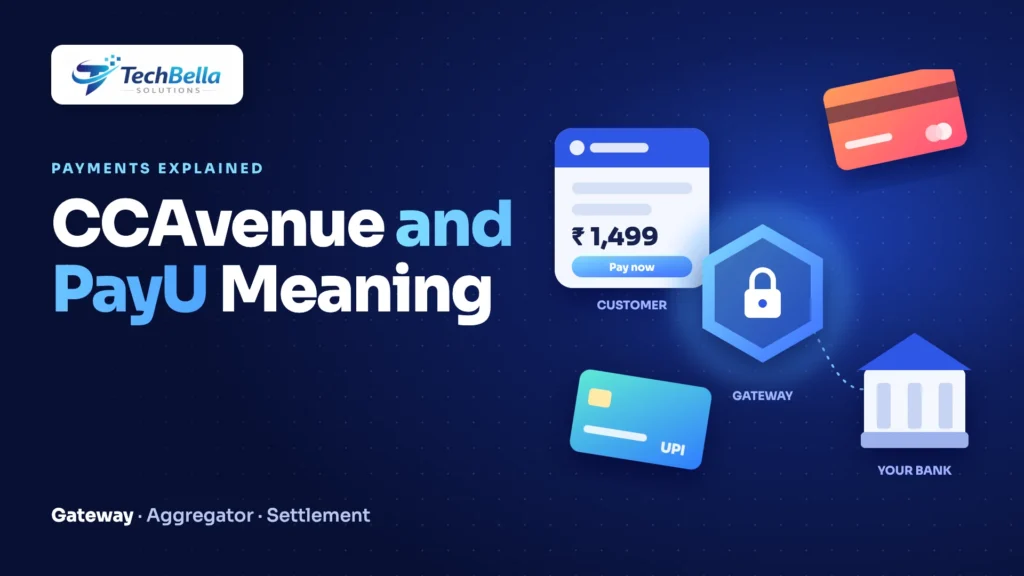
A payment gateway is the technology. It collects the customer’s payment details securely, passes them to the right bank or card network, and returns “approved” or “declined” to your website. Think of it as the card machine, but online.
A payment aggregator is a regulated business that also handles the money. In India, the Reserve Bank of India regulates payment aggregators: they accept payments from customers on behalf of many merchants, hold the funds briefly, and then settle them to each merchant. This is why a small business can start accepting payments without negotiating a separate bank arrangement.
CCAvenue and PayU both offer the gateway technology, and both describe themselves as payment aggregators for Indian merchants. Because authorisations can change, check the current status in the Reserve Bank of India’s published lists on rbi.org.in before you rely on anyone’s claim, ours included.
How a payment travels through CCAvenue or PayU
The same path applies to both, which is why the CCAvenue and PayU meaning is so similar in practice:
- The customer clicks “Place order” on your store.
- Your store sends the order amount, currency and an order reference to the gateway.
- The customer picks a method (card, UPI, net banking, wallet) on the gateway’s page and authenticates it, for example with a card OTP or a UPI PIN.
- The gateway talks to the customer’s bank or the card network and gets an approval or a decline.
- The gateway sends the result back to your website. A well-built plugin marks the order paid, failed or pending based on that response.
- Later, following your agreement, the money is settled to your bank account, minus the gateway’s charges.
Two things are worth noticing. First, the customer’s card details never touch your server when you use a redirect or hosted page, which keeps your own security burden smaller. Second, the result reaches your site in a separate step (a callback), which is where most WooCommerce payment problems start. If orders get stuck on “pending”, our guide to CCAvenue integration errors covers the usual causes.
CCAvenue and PayU meaning side by side
The table keeps to things each provider says about itself or that are true of the business model. It deliberately avoids prices and success-rate claims, because those change and depend on your business category.
| Question | CCAvenue | PayU |
|---|---|---|
| Who owns it | Infibeam Avenues Limited | Prosus |
| What you get | Online payment gateway with many payment modes and multi-currency support | Online payment gateway with checkout tools, payment links and related business products |
| Where it is based | India, with a UAE operation at ccavenue.ae | India, as part of a global payments group |
| Credentials you receive | Merchant ID, Access Code, Working Key | Key and salt or similar, depending on the product |
| How customers pay | Redirect to a hosted payment page | Redirect or hosted form, depending on the integration |
| Fees | Set in your agreement, based on your business | Set in your agreement, based on your business |
The terms you will meet once you sign up
Whichever provider you pick, the dashboard and the contract use the same handful of words. Knowing them makes the CCAvenue and PayU meaning much less abstract:
- Merchant account: your approved profile with the provider. Everything else hangs off it.
- Credentials: the identifiers and secret keys your website uses to talk to the gateway, such as a Merchant ID, an access code and a working key. Treat them like passwords and never paste them into emails or screenshots.
- Test mode and live mode: the same account has a sandbox for practice payments and a live environment for real money. Credentials usually differ between the two.
- Callback or return URL: the address on your site where the gateway sends the customer, and often a server message, after payment. If it is blocked by a firewall or cached, orders stay “pending”.
- MDR: the merchant discount rate, the percentage the provider keeps from each successful payment.
- Settlement: the transfer of your money to your bank account, after fees.
- Chargeback: a payment the customer disputes with their bank, which can reverse the money and add a fee.
- Reconciliation: matching your orders to what the bank actually received. A good report makes this a ten-minute job instead of a monthly headache.
Which one suits a WooCommerce store?
Both providers can be connected to WooCommerce, so the technical answer is “either”. The practical answer depends on three things.
Your customers. For a mainly Indian audience paying by UPI, cards and net banking, both will cover the basics. If you also sell in the UAE or accept foreign currencies, CCAvenue’s UAE arm and multi-currency options are worth a closer look, but check eligibility: its UAE services depend on your company’s status. Our UAE setup guide explains the eligibility point in detail.
Your plugin. The gateway is only half of the experience; the WooCommerce plugin is the other half. Check that the version you plan to use supports your WooCommerce release, the block-based checkout, refunds from the order screen and test mode. If you want a maintained CCAvenue plugin, see our CCAvenue Pro plugin for WooCommerce.
Your support needs. Payment problems are urgent. Ask each provider how you reach them, how fast they answer, and what they need from you to investigate a failed transaction.
For a direct, point-by-point comparison, read our full CCAvenue vs PayU guide. If Razorpay is also on your shortlist, see CCAvenue vs Razorpay vs PayU.
Need CCAvenue set up properly on your WooCommerce store?
We configure and test payment gateways on WordPress and WooCommerce stores in India and the UAE, including checkout blocks, order status updates and refunds.
Frequently Asked Questions
What is the meaning of CCAvenue?
CCAvenue is the payments brand of Infibeam Avenues Limited, an Indian fintech company. It is an online payment gateway and aggregator that lets websites accept cards, UPI, net banking, wallets and other payment modes. The name has no official technical meaning; “CC” is commonly read as credit card and “Avenue” as a shopping street.
What is the meaning of PayU?
PayU is a payments company owned by Prosus, a global consumer internet group. In India it provides an online payment gateway and related tools for merchants. The name is commonly read as “Pay you”, but that is an informal reading and not an official definition.
Is CCAvenue the same as PayU?
No. They are separate, competing companies with different owners, merchant agreements, dashboards and plugins. They do similar jobs, which is why people compare them.
Are CCAvenue and PayU payment gateways or payment aggregators?
Both provide payment gateway technology and describe themselves as payment aggregators for Indian merchants. Authorisations can change, so check the Reserve Bank of India’s current list before relying on any claim.